
![[HERO] Beyond the '6-Second' Rule: What Modern Recruiters Actually See in 2026](https://cdn.marblism.com/p0ZCl33kRTI.webp)
The old advice is dead. Buried.
For a decade, career coaches told you that you had six seconds to impress a human. They told you to use a "clean layout" and a "professional summary." They were wrong then, and they are dangerously wrong now.
It is 2026. No human is looking at your resume for six seconds. In fact, most humans aren't looking at your resume at all until an algorithm tells them you are worth the effort.
The "6-second rule" has been replaced by the 0.1-millisecond scan.
Today’s recruiters don't open PDFs one by one. They live inside AI-augmented dashboards that act as judge, jury, and executioner before a single human eye touches your application. If you aren't optimizing for the machine, you aren't just losing the game: you aren't even on the field.
The Recruiter’s Cockpit: How They See You
When a recruiter at a top-tier firm opens their terminal, they aren't looking at a stack of paper. They are looking at a prioritized data feed.
Modern Applicant Tracking Systems (ATS) now function as predictive engines. Instead of a list of names, recruiters see a Match Score. They see Keyword Gap Analysis visualizations. They see Predictive Performance Ratings.
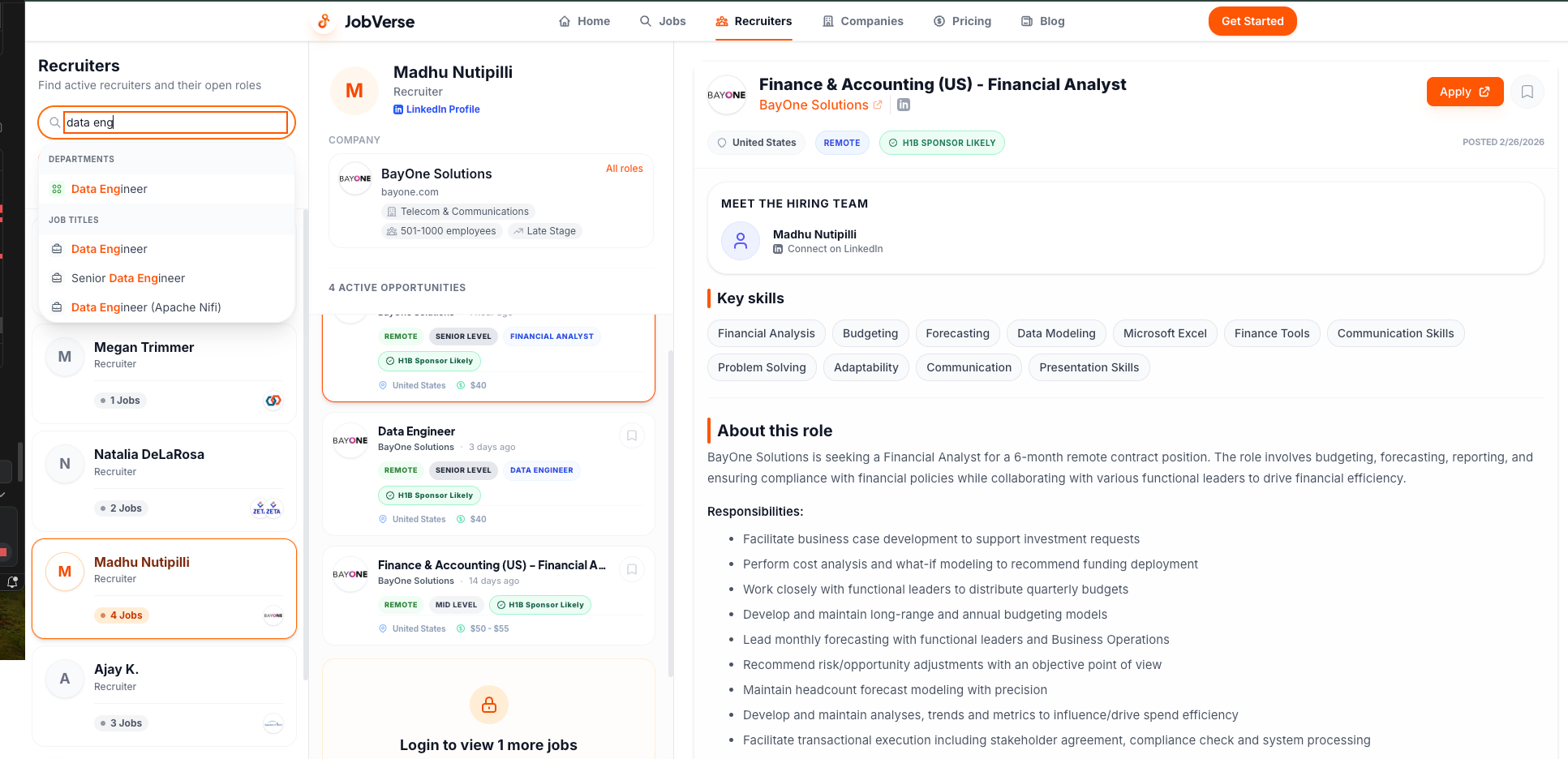
In 2026, recruiters use these dashboards to filter out 95% of applicants instantly. They don't "skim" your experience; the AI extracts the intent behind your words.
If the dashboard shows a 70% skill gap, your application is archived. Automatically. No human intervention. To break through, you need to understand that you are writing for a high-speed processor, not a person.
The Myth of Keyword Stuffing
The "old" way to beat the bots was simple: find keywords in the job description and pepper them throughout your resume.
That doesn't work anymore.
In 2026, AI filters use semantic matching. They understand context. If you list "Python" ten times but don't describe complex environments where you used it, the AI flags you as a "keyword stuffer." It knows you're trying to game the system, and it punishes you for it.
Recruiters now see a "Competency Map." The AI looks for the logic in your career progression. It looks for quantifiable impact hidden in your bullet points. If your resume is just a list of nouns, you are invisible.
You need to perform a rigorous keyword gap analysis before every single submission. You need to know exactly which technical skills the AI is hunting for and prove you have them through actionable evidence.
If you’re still guessing which parts of your resume are failing, you’re already behind. You need to stop falling into The ATS Trap: 7 Mistakes You’re Making with Resume Checkers and start using tools that actually show you the rejection triggers before you hit send.
Weaponizing the Resume
To survive the 2026 job market, your resume shouldn't just be a history of where you’ve been. It needs to be a precision-guided missile aimed directly at the recruiter’s dashboard requirements.
This is why we built the Resume Weaponizer.
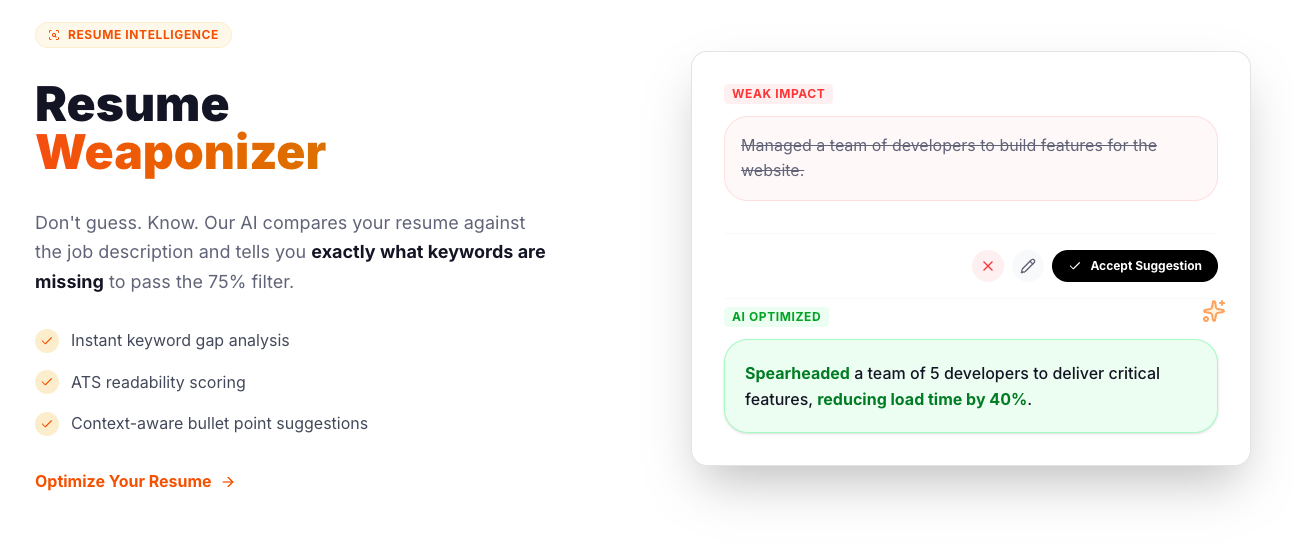
The Weaponizer doesn't just "check" your resume. It dissects it. It runs the same semantic analysis that top-tier recruiters use. It identifies the exact gaps between your experience and the job target.
Stop guessing. The system tells you exactly which bullet points are weak and provides context-aware suggestions to fix them. It transforms "Managed a team" into "Spearheaded a cross-functional squad of 5, delivering a 40% reduction in latency."
The difference isn't just word choice. The difference is becoming a 'Target Acquired' status on the recruiter's screen.
The AI Cover Letter: Your Secret Intelligence
Recruiters in 2026 are overwhelmed by volume. They receive thousands of applications for a single remote role. To cope, they use AI to summarize your "intent."
If your cover letter is a generic template, the AI summary will be blank.
The secret to winning in 2026 is personalization at scale. You need to show the recruiter: and their AI filter: that you understand their specific pain points. You can't do this manually for fifty jobs. You'll burn out.
You need to deploy an AI cover letter generator that can ingest the job's deep requirements and output a letter that feels human, but is technically optimized for the filter. Check out The AI Cover Letter Hack: How to Personalize Applications at Scale to see how to automate this without losing your soul.
The "Pulse" of the Market
Traditional job boards are graveyards. By the time a job is posted on a major platform and indexed by Google, it's already over.
Modern recruiters use precision-sourcing. They look for candidates who are active in the market now. They want candidates who have "The Pulse."
At Jobverse, we monitor over 100,000 active listings in real-time. We don't just show you jobs; we show you intel. We show you which companies are H1B sponsors, which ones are scaling their engineering teams, and which ones are "ghosting" applicants.
If you are still searching manually, you are bringing a knife to a laser-grid fight.
Set Your Perimeter: Automated Scouting
In 2026, the best candidates don't "hunt" for jobs. They set traps.
Recruiters move fast. High-salary roles at top companies like Netflix or OpenAI often close within 48 hours. If you aren't the first to apply, you are the last to be considered.
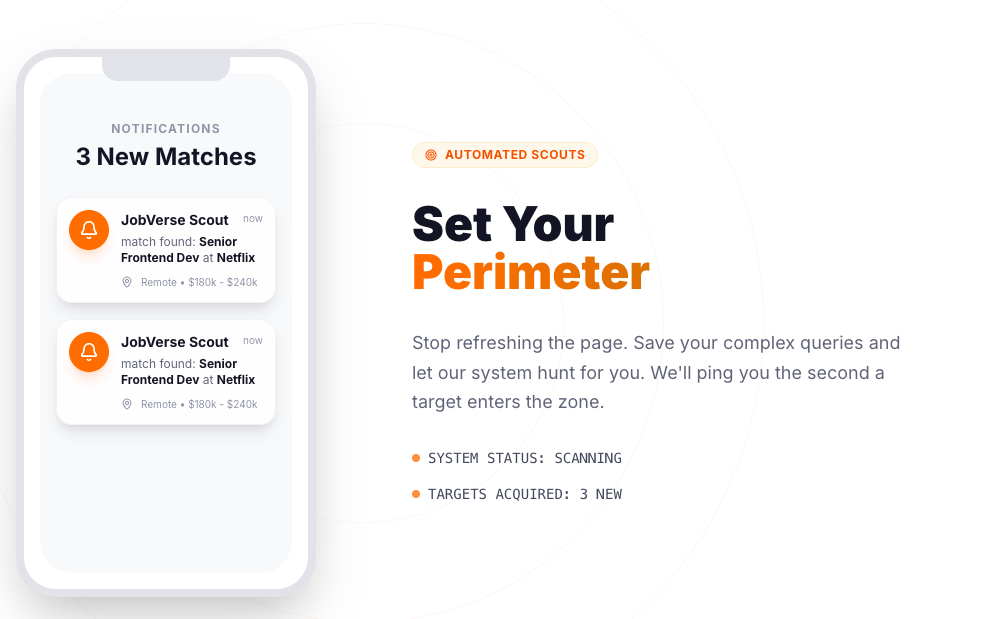
You need to set your Perimeter. You need Automated Scouts that scan the entire web: not just one site: and ping you the second a match is acquired.
Don't check job boards. Let the job boards check in with you. When you get a notification that a Senior Frontend role has just opened, you should be able to deploy your weaponized resume in seconds.
What They Actually Evaluate (The Human Part)
If you get past the AI filters: if you actually make it to the recruiter’s "Shortlist" view: the evaluation changes.
In 2026, recruiters are looking for evidence of learning potential.
Technology moves too fast for credentials to matter as much as they used to. A degree from 2020 is ancient history. They want to see demonstrable skills. They want to see projects. They want to see that you are an insider who knows the latest tools.
When the human recruiter finally looks at your profile, they aren't looking for "Years of Experience." They are looking for "Value Realized."
Break the System
The recruitment process is a machine designed to exclude you. It is built to filter, to categorize, and to reject.
You have two choices.
You can continue to play by the rules of 2019. You can send your generic PDF into the void and wonder why you never hear back. You can keep believing in the "6-second rule" while an algorithm rejects you in 0.1 milliseconds.
Or you can weaponize.
Use the best job boards. Use AI to bridge your keyword gaps. Set your scouts to find the startup jobs before they go public.
The system is rigged, but it is also predictable. Once you understand what the recruiters are actually seeing on their side of the screen, the "void" disappears.
Stop applying. Start dominating.
Get Started with Jobverse for Free. No credit card. No fluff. Just the tools you need to win the hunt.