
![[HERO] Beyond the $200k Ceiling: How to Find (and Land) High-Impact Executive Tech Roles](https://cdn.marblism.com/hceSp8htkN8.webp)
Here's the uncomfortable truth: Most job platforms actively hide the positions you actually want.
The $200k+ roles? Buried under fifty layers of "competitive salary" nonsense. The executive openings? Invisible unless you know the exact Boolean string to unlock them. The Staff Engineer positions that could double your comp? They're there. You just can't see them.
Until now.
The $200k Salary Floor Isn't a Myth: It's Just Hidden
While platforms like LinkedIn play coy with salary ranges, Jobverse is tracking over 24,000 active positions with salaries starting at $200k.
Not "estimated." Not "competitive." Actual disclosed salary floors.
These aren't fantasy roles. They're live openings for:
- Chief Technology Officers commanding $175k-$300k+
- Principal Engineers pulling $180k-$280k base
- Directors of Engineering at $200k-$350k
- Chief Information Officers breaking $250k easily
- VP of Product roles starting at $220k
- Head of Data/ML positions reaching $320k+
The talent is out there. The roles exist. The disconnect? Visibility.
Why Traditional Platforms Bury High-Salary Roles
Most job aggregators treat executive positions like state secrets. Here's why:
They're protecting their premium tiers. Want to see salary data? Upgrade to LinkedIn Recruiter for $10k/year. Need executive search filters? That's another paywall.
They're optimizing for volume, not value. Their algorithms push entry-level and mid-level roles because there are more of them. High-impact positions get buried 47 pages deep.
They don't validate salary data. Those "estimated" ranges? Pulled from outdated surveys and wild guesses. Useless for negotiation. Dangerous for decision-making.
Jobverse flips this entirely. Every role we index includes raw salary data when disclosed. No estimations. No hiding behind paywalls. You want to filter by $200k minimum? Done. Need to see $300k+ only? Set your perimeter and let the system hunt.
The Executive Tech Roles Actually Worth Your Time
Not all six-figure roles are created equal. Here's what separates real executive impact from inflated titles:
Staff+ Engineering Positions
These are technical leadership roles where you're setting architecture, mentoring teams of 10-30 engineers, and influencing product direction. Think less "Senior Engineer with extra meetings" and more "Technical authority with organizational reach."
Salary range: $180k-$280k base, plus equity that actually matters.
Director/VP of Engineering
You're running multiple teams, setting technical strategy, and reporting directly to the C-suite. Your decisions affect hundreds of engineers and millions in infrastructure spend.
Salary range: $200k-$350k+, with equity packages reaching seven figures.
Principal Product Manager/Head of Product
You're not managing features. You're defining market positioning, orchestrating cross-functional initiatives, and owning entire product lines. Board-level visibility is standard.
Salary range: $180k-$300k, with performance bonuses that double base in good years.
C-Suite Technical Roles (CTO, CIO, CISO)
You're setting company-wide technical vision, managing eight-figure budgets, and sitting on the executive team. These aren't "manager" roles: they're business leadership positions that require deep technical credibility.
Salary range: $250k-$500k+, with equity that can eclipse cash comp.
How to Actually Find These Roles (Without Recruiter Spam)
Most executive job seekers are doing it backwards. They're:
- Setting up fifty LinkedIn alerts that ping them about "Senior Software Engineer" roles they don't want
- Talking to executive recruiters who ghost them after the first call
- Manually checking company career pages like it's 2015
- Networking on autopilot without targeted outreach
Here's the tactical approach that actually works:
1. Set Your Salary Floor and Stop Wasting Time
Go to Jobverse's $200k+ filter and set your actual minimum. Not what you hope to negotiate to. Your walk-away number.
This instantly eliminates 94% of the noise. No more "competitive salary" roles where "competitive" means $140k in a $200k market.
2. Layer in Location and Remote Preferences
Executive roles are increasingly remote-friendly, but compensation varies wildly by company HQ location. A Director of Engineering role at a Bay Area startup pays different than the same title at a distributed company with no geographic pay adjustments.
Filter accordingly. Know your boundaries.
3. Use Automated Scouts to Monitor New Openings
Here's where most people fail: They search once and forget to check back.
Executive roles don't stay open long. The best positions fill through backchannels before they're even publicly posted. You need continuous monitoring.

Jobverse's Scout feature pings you the moment new roles matching your exact criteria hit the market. Real-time alerts. Zero manual checking. You see openings hours after they're posted, not weeks.
Optimize Your Resume for High-Stakes Applications
Here's the part where most executives shoot themselves in the foot: They're applying to $300k roles with resumes built for $120k positions.
At executive level, your resume isn't a chronological work history. It's a strategic document proving organizational impact.
Every bullet needs:
- Quantified business outcomes (revenue, cost savings, team scaling)
- Scope indicators (budget size, team size, customer reach)
- Technical depth that proves you're not just a "manager who used to code"
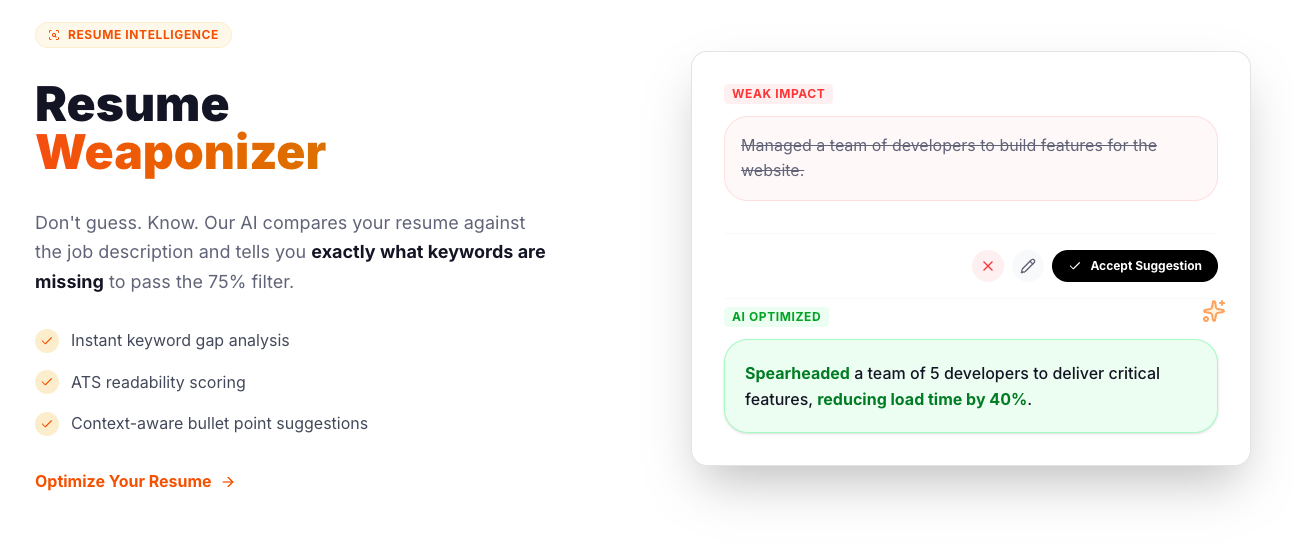
This is where Jobverse's Resume Weaponizer becomes critical.
What the Resume Weaponizer Actually Does
It's not a template library. It's instant feedback on whether your resume will survive executive-level ATS systems and impress technical hiring committees.
The tool analyzes:
- Keyword gaps: Are you using the exact technical terms the role requires?
- ATS readability: Will your formatting break when parsed by applicant tracking systems?
- Impact density: Are your bullets demonstrating leadership or just listing responsibilities?
Example transformation:
Before: "Managed a team of developers working on backend infrastructure."
After: "Led a team of 12 backend engineers to re-architect core API infrastructure, reducing latency by 60% and cutting AWS costs by $2M annually."
One sentence. The difference between getting an interview and getting auto-rejected.
The Mindset Shift Required at $200k+
Executive job searches operate on different rules. Stop thinking like a mid-level candidate trying to "get past HR." Start thinking like a business leader evaluating mutual fit.
You're not hoping they pick you. You're vetting whether they deserve your expertise.
This changes everything:
- Your resume emphasizes strategic outcomes, not technical tasks
- Your interviews focus on business challenges you've solved, not coding puzzles
- Your salary negotiations start from market data, not hope
- Your timeline expectations adjust: executive hiring cycles run 6-12 weeks, not 2-3
Start Your Hunt Now
The roles are live. Over 24,000 of them above $200k.
Set your filters. Activate your Scouts. Weaponize your resume.
The platform is free. The data is real. The opportunity is now.
Stop settling for "competitive" when you can filter by actual numbers. Break through the $200k ceiling and find the executive role that actually matches your experience.
No credit card required. No recruiter spam. No guessing at salary ranges.
Just raw data, instant alerts, and the tools to land roles that pay what you're worth.