
![[HERO] The 2026 Pay Transparency Playbook: Decoding the New Salary Disclosure Laws](https://cdn.marblism.com/6xMmqRdSHpz.webp)
The era of the black box salary is dead.
For decades, companies held all the cards. They knew the budget. You knew nothing. They asked for your "salary expectations" like a trap. If you guessed too high, you were out. If you guessed too low, they saved a fortune at your expense.
2026 changed everything.
New laws in the US and the EU have forced the corporate machine to show its hand. But don't be fooled. Just because they’re required to show a range doesn’t mean they’re playing fair. They are using vague brackets and hidden clauses to keep you in the dark.
This is your playbook. It’s time to stop guessing and start dominating the negotiation.
The 2026 Battlefield: Where the Laws Stand
The legal landscape has shifted. As of February 2026, the perimeter has expanded. 17 US states and the entire European Union have locked in pay transparency mandates.
In the US, California’s Senate Bill 642 and the Massachusetts Wage Transparency Act are now fully operational. If a company has more than 15–25 employees, they must disclose the "good faith" pay scale. No more "competitive salary" nonsense.
In the EU, the Pay Transparency Directive is dismantling the gender pay gap. It’s not just about the posting. You have the right to know the average pay levels for workers doing the same work.
The system is finally leaking intel.
But here is the reality: salary visibility is only a weapon if you know how to wield it. Companies are retaliating with "The Wide Range Trap." They post a range of $100,000 to $250,000. That isn't transparency. That's a smokescreen.

Decoding the "Wide Range" Smokescreen
When you see a range that could fit two different lifestyles, you aren't looking at a budget. You’re looking at a test.
Companies use these massive spreads to catch desperate candidates who will settle for the floor. They call it "geographic differentials" or "experience-based scaling." We call it a negotiation hurdle.
How to extract the real target:
- The 75% Rule: In 2026, most "good faith" offers actually land at the 75th percentile of the posted range for a qualified candidate. If the range is $120k–$180k, your target is $165k.
- The Remote Job Search Pivot: If you are conducting a remote job search, companies often try to pin you to the lowest local market rate. Don't let them. Use Jobverse to find what that role pays in San Francisco or New York, regardless of where your desk is.
- The "Ghost" Audit: If the salary looks too good to be true, it might be. Check our guide on The Ghost Job Pandemic to see if that high-paying listing is even a real hire or just a marketing stunt.
Weaponizing Jobverse Intel
Searching for a job without data is like walking into a knife fight with a toothpick. You need heavy artillery.
Jobverse doesn't just show you the range. It cross-references the listing against real-time market data, company funding stages, and historical hiring patterns.
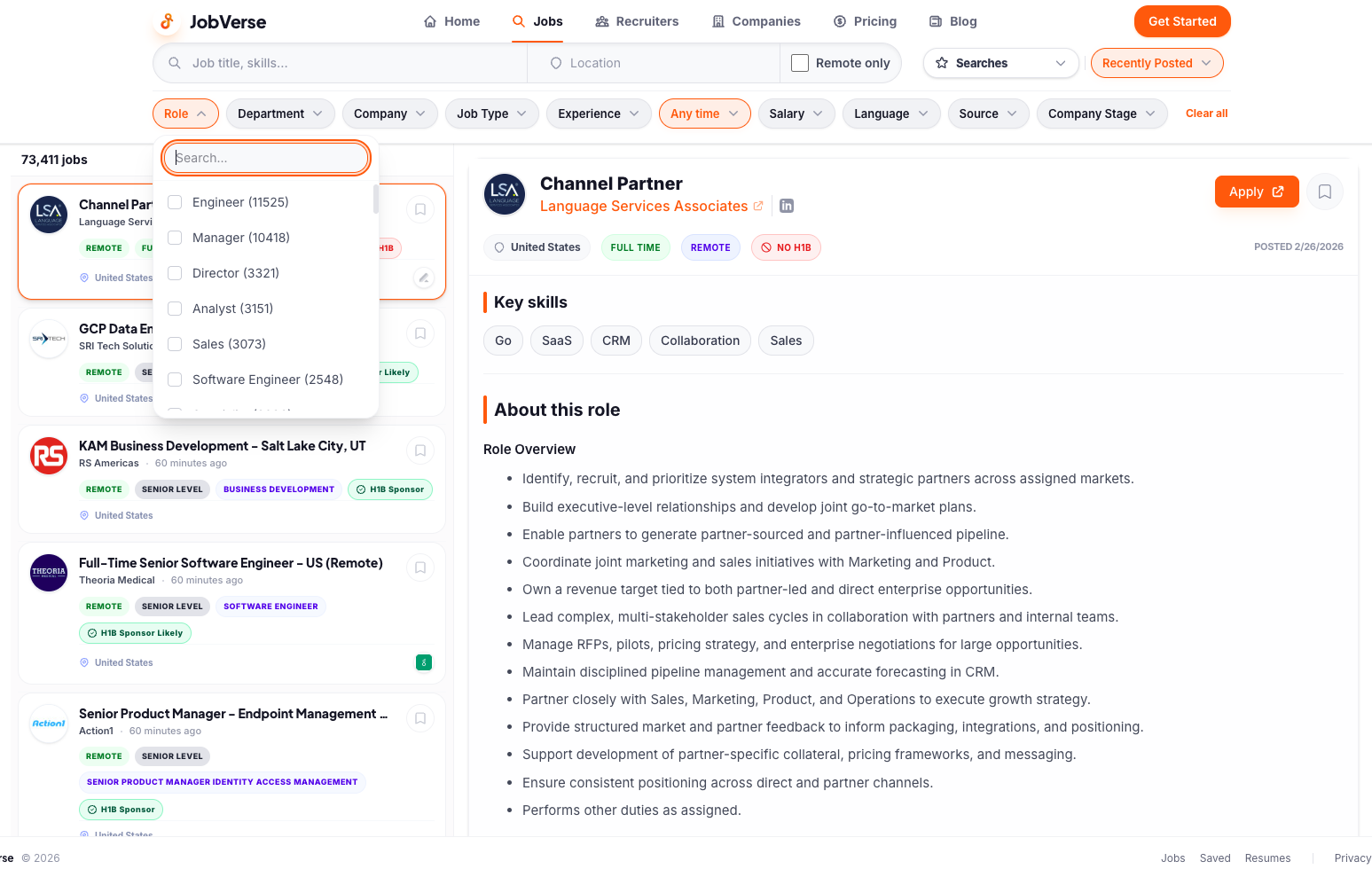
When you use our advanced search, you aren't just filtering by "Engineer." You are filtering by leverage.
Set Your Perimeter with Scout
Stop refreshing boards. It’s a waste of your biological processing power.
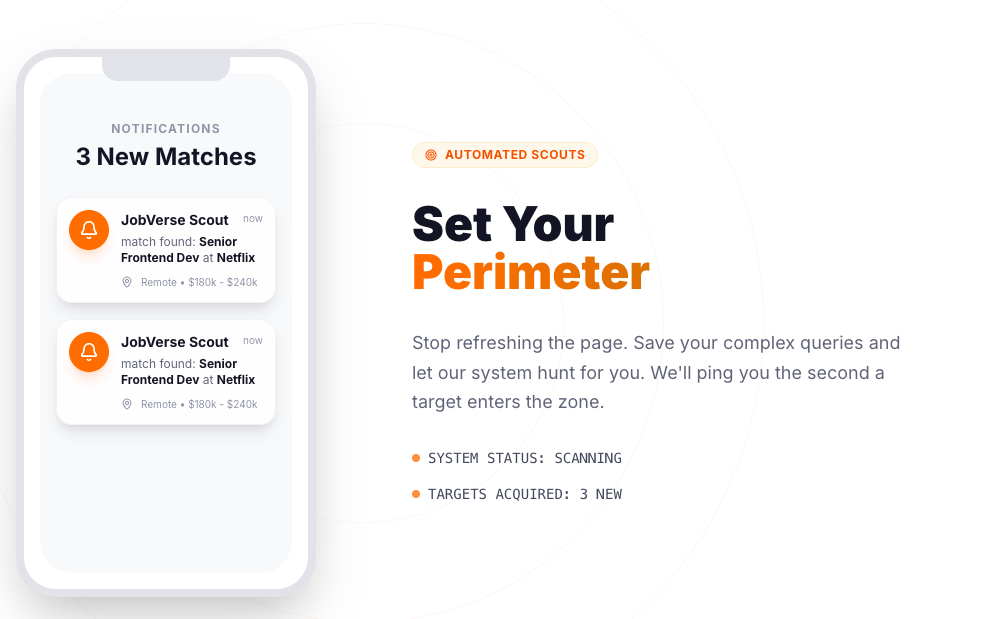
Our Jobverse Scout acts as your automated intelligence officer. You set the parameters:
- Minimum Floor: Never see a job under $150k again.
- Location: Only remote-first companies that respect transparency.
- Status: Only active, verified targets.
The moment a role matching your job alerts hits the wire, Scout pings you. You are the first in the door. You are the one setting the tone.
High-Stakes Hunting: The $200k+ Tier
Transparency laws get fuzzy the higher you go. For Senior, Lead, and Executive roles, companies often try to move the conversation to "total compensation" (TC) to hide the base salary.
They will throw stock options and "unlimited PTO" at you to distract from a stagnant base. In 2026, cash is king. Inflation and market volatility mean you cannot pay rent with "potential" equity.
If you are aiming for the top tier, you need to look at our deep dive: Beyond the $200k Ceiling: How to Find (and Land) High-Impact Executive Tech Roles.
The strategy for a senior role is different. You aren't just an applicant; you’re an investment. You need to prove ROI before they even ask about your price tag.
Tactical Negotiation: Using the Law as a Shield
In the interview, the "Salary Question" will still come up. Even with transparency laws, recruiters will try to get you to blink first.
Recruiter: "The range for this role is $130k to $190k. What are you looking for?"
The Amateur Answer: "I'm flexible, somewhere in that range." (You just lost $40k).
The Jobverse Answer: "Based on the 2026 transparency disclosures for this jurisdiction and the current market data for a high-salary role at a Series C startup, I am targeting the top quartile of your range. My specific skill set in AI-integration and system architecture puts me at the $185k mark. Let's talk about how I can hit your Q3 targets."
You didn't just give a number. You gave justification. You used their own required disclosure against them.
Resume Weaponization: Matching the Value to the Price
If you want the top of the range, your resume can't look like a generic template. It needs to be an optimized strike document.
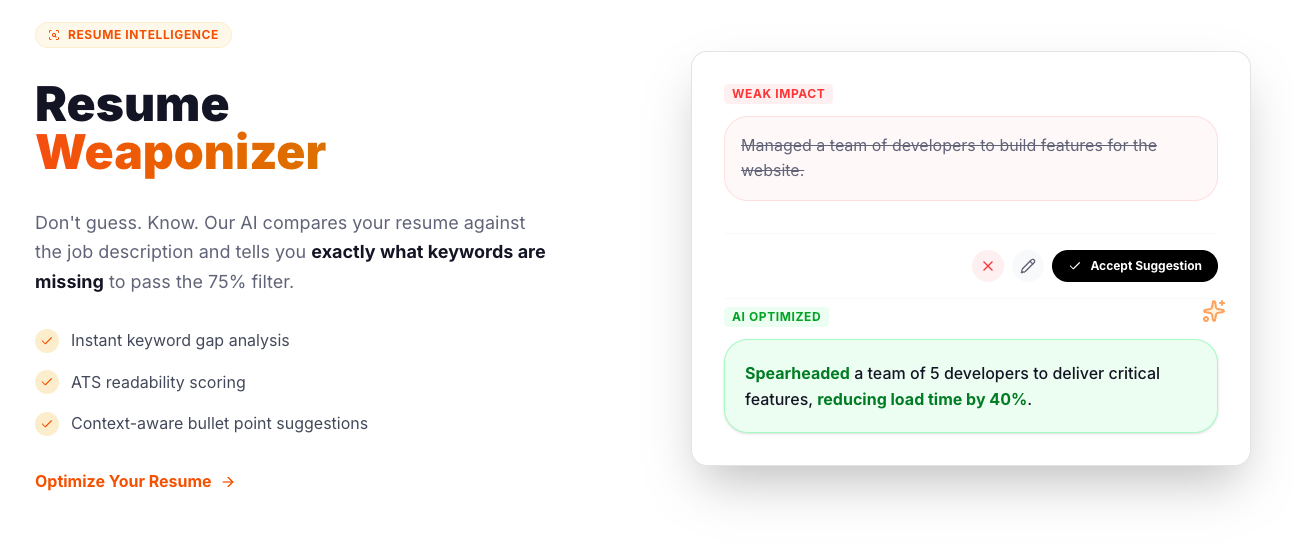
If the job pays $200k, the ATS (Applicant Tracking System) is tuned to look for $200k-level keywords. If your resume is built for a $100k role, you will be filtered out before a human even sees your "target salary."
Use the Resume Weaponizer to close the gap. It scans the job description, identifies the high-value keywords, and re-frames your experience to match the pay grade.
Don't just apply. Dominate.
The 2026 Transparency Checklist
Before you hit "Apply" on your next startup job, run this diagnostic:
- Is the range compliant? If they aren't showing a range in CA, NY, or WA, they are breaking the law. That’s a red flag for company culture.
- What is the "Floor" vs. "Ceiling"? Is the spread more than 50%? If so, the company is likely hiding the true budget.
- Does the TC include benefits? 2026 laws in places like New Jersey now require a description of benefits. Check the health plan and 401k match: they are part of your "real" salary.
- Are you using Jobverse? If you're manually searching, you're losing. Use our live pulse to see roles as they go live.
Stop Playing Defensive
The market in 2026 is faster, louder, and more automated than ever. The laws gave you a crack in the door. Jobverse gives you the battering ram to kick it down.
Transparency is not a gift from HR. It is a tool for the informed. Every time you accept a job without knowing the full range, you are leaving money on the table for someone else to spend.
Target acquired. Perimeter set. It's time to get paid.

Ready to see what you're actually worth?
Hunt for High-Salary Roles Now
No credit card required. No corporate fluff. Just the data you need to win.