
![[HERO] The ATS Trap: Why 75% of Resumes Are Ignored (and How to Beat the Bots)](https://cdn.marblism.com/HL5davvD992.webp)
You spend three hours tweaking your resume. You verify every date. You check every comma. You hit "Apply."
Then? Silence.
No "thank you" email. No "we’ve moved in another direction." Just a digital void. You feel like you’re shouting into a canyon, but there isn’t even an echo.
Here is the brutal truth: You aren’t being rejected by a person. You’re being filtered out by a machine.
Most companies use an Applicant Tracking System (ATS). It is a gatekeeper. It is a bot designed to find reasons to ignore you. In fact, research shows that nearly 75% of resumes never reach a human recruiter. They are scored, ranked, and buried in a database because they didn't speak the machine's language.
It’s time to stop playing by their rules. It’s time to weaponize your search.
The Anatomy of the Trap
An ATS isn't "smart." It doesn't understand your "passion" or your "hustle." It’s an ATS resume checker that parses text to find specific matches. If the match isn't there, you don't exist.
The system scans for three things:
- Keywords: Does your resume contain the exact skills listed in the job description?
- Formatting: Can the bot actually read your file, or did your "creative layout" break its brain?
- Thresholds: Do you meet the rigid, non-negotiable experience requirements set by the recruiter?
If you fail any of these, the system marks you as a "low match." You might be the most qualified person for the job, but if the bot gives you a score of 40%, a human will never click on your profile.

Formatting: The Silent Killer
Candidates love fancy resumes. Columns. Charts. Graphics. Images.
The ATS hates them.
When an ATS encounters a complex layout, it usually scrambles the text. Your "Work Experience" gets merged with your "Skills" section. Your dates get disconnected from your titles. The result? A garbled mess that looks like a technical error to the recruiter.
- Tables are traps. Most bots can’t read data inside a table.
- Headers and Footers are invisible. Never put your contact info in the header.
- PDFs can be risky. While modern systems handle them better, a plain-text .docx is still the gold standard for resume optimization.
If the bot can't parse it, the bot can't rank it. You’re dead on arrival.
The Keyword Gap: Speaking "Bot"
Recruiters don’t search for "team players" or "hard workers." They search for hard skills.
If the job description asks for "Python" and "Data Visualization," and your resume says "Coding" and "Making Charts," you lose. The machine is looking for a literal match.
This is where most seekers fail. They send one "general" resume to fifty jobs. That is a losing strategy. Every job description is a cipher. You need to decode it and feed the exact keywords back into the system.
When you’re hunting for specialized roles, the keyword density becomes even more critical. If you are targeting a remote niche, for example, your resume needs to emphasize specific tools and methodologies. Check out our Remote Product Manager’s Playbook to see how deep those keyword requirements actually go.
Higher Stakes at the Top
The higher the salary, the narrower the filter.
For entry-level roles, companies might be flexible. But for high-impact executive positions, the ATS is set to "ruthless." One missing keyword or a year-long gap can trigger an automatic rejection.
At this level, you aren't just fighting a bot; you're fighting a highly calibrated screening engine designed to find the top 1% of applicants. We’ve seen candidates with decades of experience get ghosted because their resume wasn't optimized for the elite-level filters. If you’re aiming for the top, read our guide on breaking Beyond the $200k Ceiling.
How to Weaponize Your Resume
Stop guessing what the bot wants. Use better intel. At Jobverse, we didn't just build a job board; we built a tactical suite for the modern hunt.
The core of our system is the Resume Weaponizer. It’s an AI-driven tool that analyzes job descriptions in real-time and compares them to your resume.
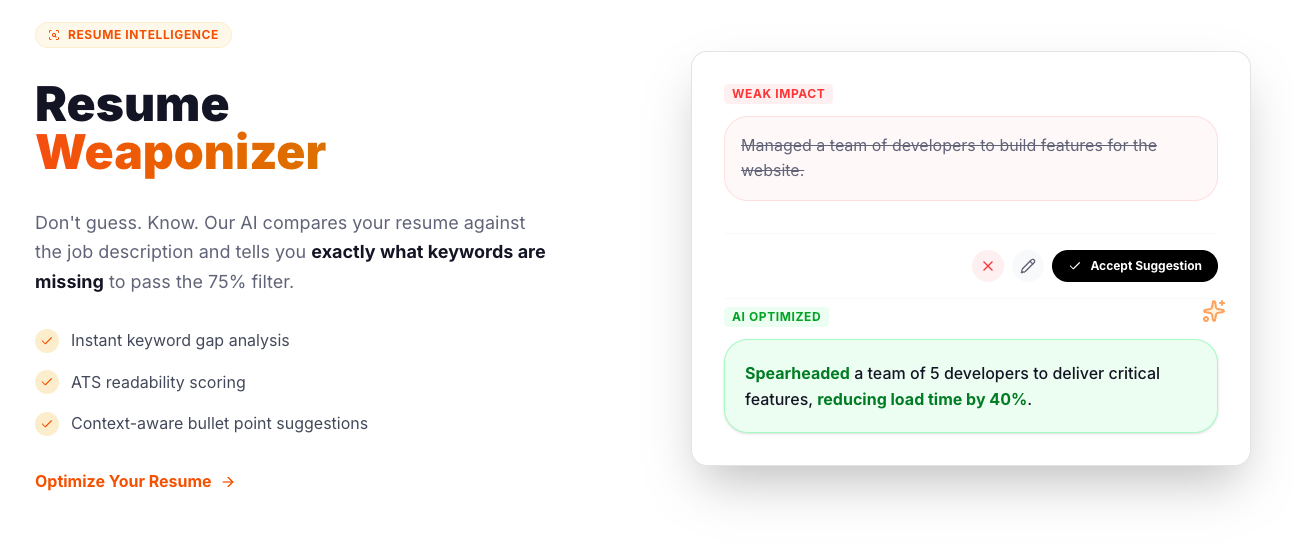
Here is how you use it to dominate the search:
1. Instant Keyword Gap Analysis
Upload your resume and paste the job link. Jobverse scans both. It identifies the exact words the ATS is looking for that you’ve missed. We show you the "missing targets" so you can add them before you hit apply.
2. Context-Aware Bullet Improvements
Don't just add keywords; integrate them. Our AI suggests ATS-friendly suggestions for your bullet points. It transforms "Led a team" into "Spearheaded a cross-functional team of 8 using Agile methodologies to increase output by 25%."
The machine wants metrics. We give you the ammunition to provide them.
3. Readability Scoring
We give you a "Battle Ready" score. If your score is low, the bots will ignore you. We tell you exactly what to fix: whether it’s formatting, verb strength, or keyword density: until your resume is invisible to the filters and visible to the humans.
Stop Searching. Start Hunting.
The old way of applying is broken. Sending a "good" resume is no longer enough. You need a resume that is engineered to win.
The ATS is a barrier, but it’s also an opportunity. Most people will continue to send generic, unoptimized resumes into the void. When you use the right tools, you aren’t just applying: you’re jumping to the top of the pile.
You’re not a "job seeker." You’re a candidate with a target.
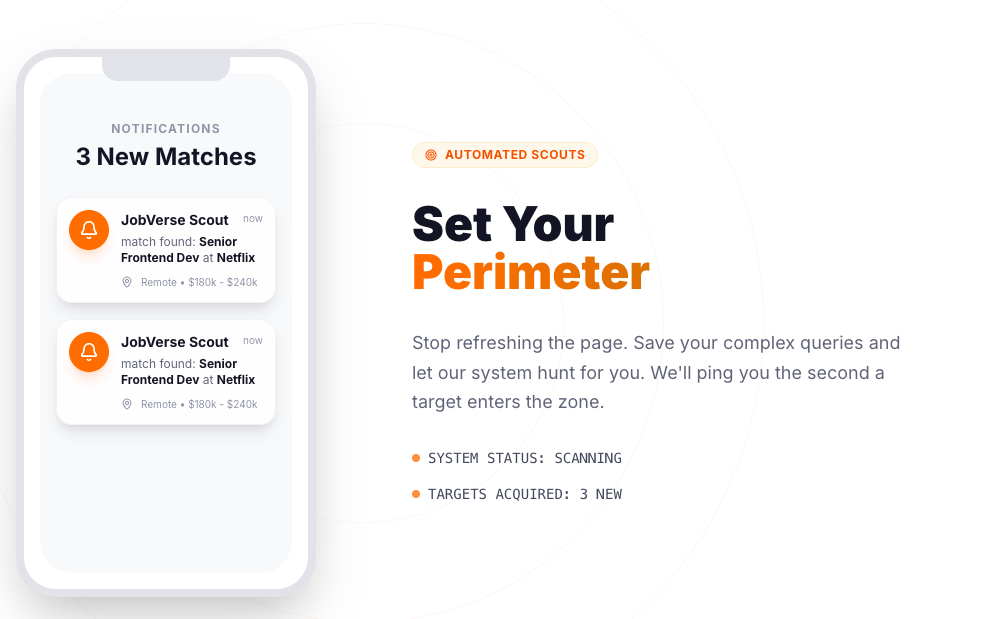
With Jobverse, you don't just find jobs; you acquire targets. Our scouts monitor the market 24/7, finding the roles that match your optimized profile. When the perfect match appears, you’ll get a pulse notification.
By then, your resume will already be weaponized.
Your Tactical Checklist
If you want to beat the bots today, do these three things:
- Strip the fluff. Remove the images, the columns, and the complex charts. Use a clean, single-column layout.
- Mirror the language. Look at the "Requirements" section of the job post. If they use a specific term three times, that term must be on your resume.
- Optimize for impact. Every bullet point should follow the formula: [Action Verb] + [Quantifiable Result] + [Method Used].
Don’t let a piece of software stand between you and your next career move. The system is flawed, but you can beat it.
Break the system. Use Jobverse to optimize your resume and start landing interviews.
Free forever. No credit card required. No more black holes.